India’s architecture doesn’t just evolve. It absorbs, adapts, and continues like a Netflix series with a 3,000-year runtime. It’s never frozen in time. And yet, even through centuries of invasions, empires, and rapid modern development, something at the core of Indian architecture holds on. The traditional and cultural values stay rooted, unshaken, unbothered, timeless.
That’s the paradox I’m exploring in this first post of my blog series Architecture Across Cultures:
How buildings change but meanings remain.
Sacred Geometry and the Architecture of Intention
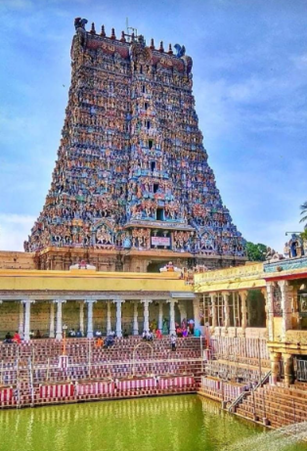
Temple Gopuram
Indian architecture didn’t begin with a love for aesthetic. It began with a deeper alignment. I’ve always found it remarkable that every ancient temple wasn’t just a place to pray. It was a cosmic diagram, a calendar, and a public square all at once.
Whether it’s the towering gopurams in the south or the intimate inner sanctums in the north, I see a consistent effort to align the human experience with divinity, with time, and with the natural world.
What’s amazing to me is how that logic still exists in the most ordinary spaces. I’ve seen verandas, stepped thresholds, and semi-open zones in homes that feel like architectural memories. They are subtle, inherited reminders of a design language rooted in purpose.
Even when people don’t consciously think about it, I think their spaces still carry some of that cosmic logic. Just… with a lot more plastic chairs and Wi-Fi routers.
I still can’t get over the fact that someone, centuries ago, carved entire buildings out of alignment with stars and seasons, and we’re still unknowingly borrowing that layout in our living rooms.
Centuries of Influence — But Never Erasure

Ellora Caves (Kailasa Temple)

Chhatrapati Shivaji Maharaj Terminus (Mumbai)
India’s architecture is the OG remix culture. I’ve always admired how Indian architecture doesn’t resist influence. It absorbs it, but never loses itself. I’ve noticed how Mughal palaces use Hindu proportions, or how colonial bungalows still follow traditional airflow patterns suited for the Indian climate. Even in Lutyens’ Delhi, what appears to be British in style actually follows Indian design logic with deep eaves, shaded spaces, and garden layouts that suit the climate and help people find their way.
What really stands out to me is how Indian architecture welcomes new ideas like a guest, offers them chai, listens politely, and then quietly reshapes them into something local, something layered, something ours.
It’s kind of wild when you think about how nothing ever gets thrown away. It just gets rewritten in a different dialect of stone, wood, or steel.
Modern India — Between Steel and Soul
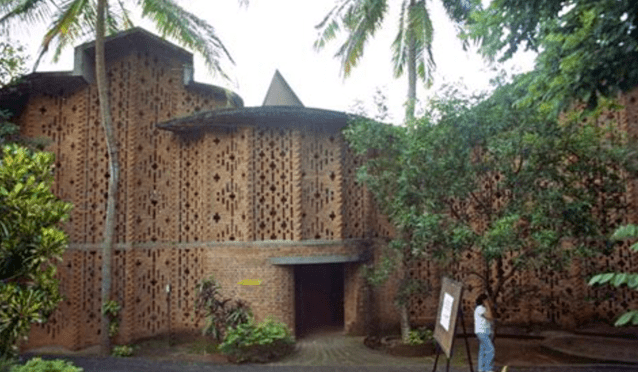
Laurie Baker home
Today, I see India building faster than ever — towers, stations, campuses. But I often find myself asking: are we still building with memory?
Some architects give me hope. When I walk through Charles Correa’s housing projects, or BV Doshi’s IIM Bangalore campus, or even see photos of Laurie Baker’s homes, I feel like I’m seeing architecture that breathes. These spaces might use concrete or brick, but they also hold silence, rhythm, and light in ways that feel timeless.
Even in the most utilitarian buildings, I’ve noticed familiar touches — patterned floors, transitional zones that invite stillness, or hidden corners where someone has placed a shrine or lamp. Subtle reminders that a building is not just used, but experienced.
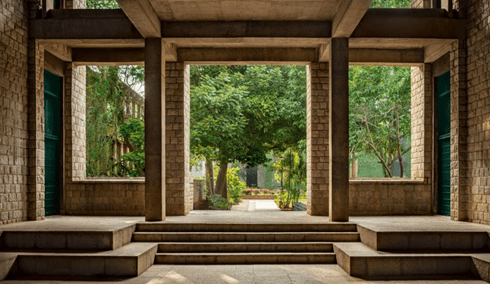
IIM Bangalore Courtyard by BV Doshi
Visual Collage: Past & Present
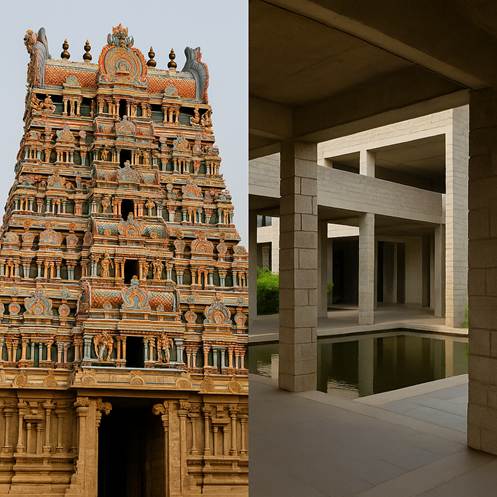
Then: Divinity in stone, carved upward toward the sky.
Now: Knowledge and community shaped through silence, rhythm, and space.
The language is new. But the story is old.
What Can We Take From This?
I’ve realized that change doesn’t have to erase culture. It can grow from it.
We’ve moved from granite to concrete, from lime plaster to glass. But what I’ve consistently noticed is that the fundamentals remain: the celebration of thresholds, the care for shade and light, the way rituals are woven into everyday movement. Even when the form shifts, the intention holds.
We may have changed the skin of our cities, but the bones underneath still feel ancient. And sometimes I think that’s exactly why they feel like home. The future is here, all glass, speed, and steel, but it still carries the fragrance of what we’ve been. And maybe that’s what makes it beautiful.
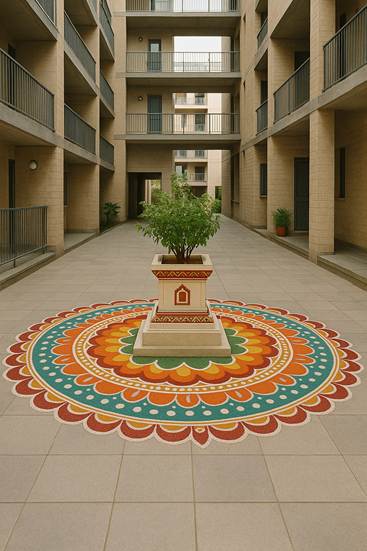
The future is here — but it still carries the fragrance of what we’ve been.
And that’s why I study architecture, not just to draw buildings, but to understand the stories they carry.
 Architecture Is Red
Leave a comment