Mexico didn’t surprise me with its history, every country has history.
What surprised me was the architecture’s confidence.
It’s bold without posturing, emotional without being sentimental, and modern without feeling like it was built by a committee obsessed with “minimalist luxury.”
This is architecture with an internal compass. They are not looking back, not trying to impress forward, just deeply sure of what space should feel like.
Geometry With Intent, Not Ego
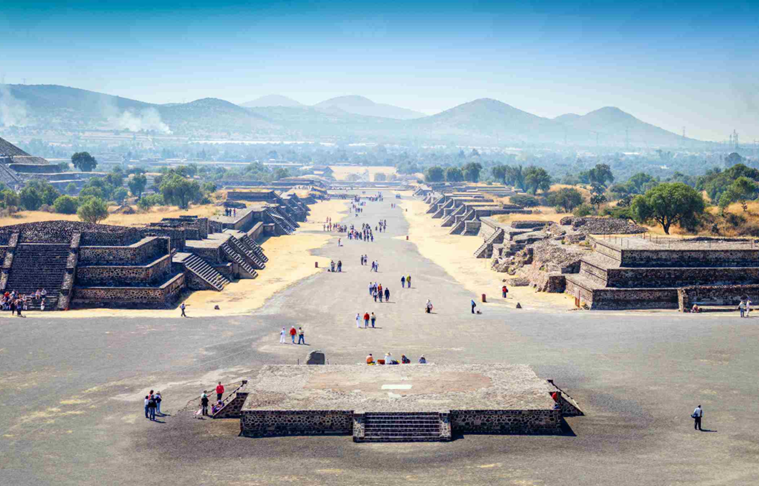
Teotihuacán Pyramid
Mexico’s ancient architecture doesn’t rely on ornament, it relies on geometry as strategy.
Pyramids designed as cosmic instruments, urban plans built around procession and axis, facades that use shadow as material.
What hit me is how architecturally disciplined these structures are.
They’re precise. They’re controlled.
They’re proof that clarity existed long before “modernism” claimed it.
And that clarity shows up again and again in Mexican architecture,
not because of nostalgia, but because the underlying logic was good, and architects kept using it.
Color as Spatial Structure
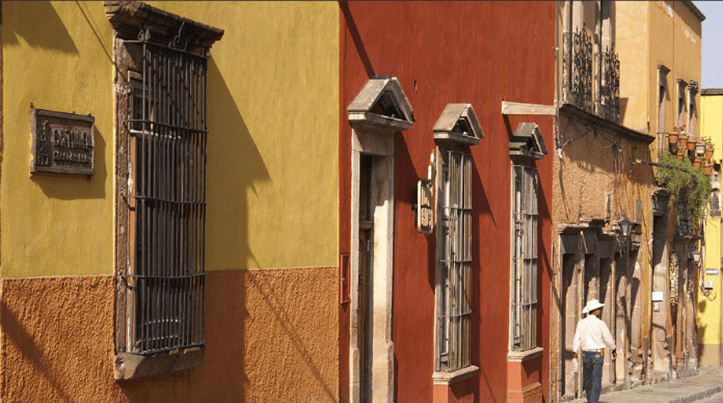
Colonial Façade
Everyone talks about Mexican color like it’s some Instagram aesthetic, it’s not.
Color here works like a material, not a surface.
Barragán knew this better than anyone.
His walls aren’t painted, they’re calibrated.
Pink becomes a plane that pushes you forward.
Yellow becomes a glow like they are lit from inside.
Blue becomes silence.
Even in contemporary Mexican homes, color is architectural, it directs circulation,
compresses or expands a space, and creates gradients of temperature and mood.
This isn’t “vibrancy.”
This is spatial psychology.
Modernism That Understands Atmosphere
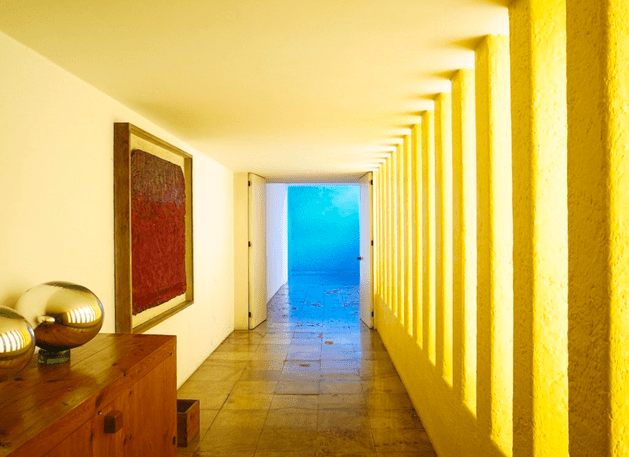
Casa Gilardi Corridor
Mexican modernism isn’t clean-lined minimalism.
It’s atmospheric engineering.
Light is treated like a visitor you make room for.
Water becomes a spatial collaborator.
Corridors slow the body.
Proportions manipulate the mind.
You’re not just in a space, you’re being guided through a sequence.
There’s nothing static about these buildings.
They breathe.
They choreograph.
They insist that architecture is an emotional experience, not an object.
Contemporary Mexico: Precision, Material, and Quiet Boldness
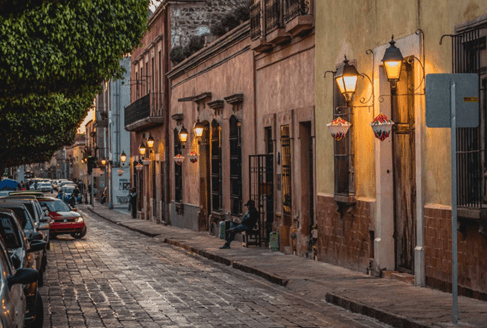
Coyoacán Street at Golden Hour
New Mexican architecture — concrete homes, courtyard houses, studio spaces — works with an obsession for material honesty.
You’ll see – concrete that feels soft because of the way it absorbs shadow, stone that stays cool in heat, courtyards that function as lungs, walls positioned for airflow rather than aesthetics.
It’s performance-driven design disguised as effortlessness.
Not traditional. Not futuristic.
Just intelligent.
Final Thought
Mexico taught me something different from Japan or Italy or India.
Not about memory.
Not about cultural layering.
But about the emotional responsibility of architecture.
Here, buildings don’t try to look important.
They try to make you feel something — calm, pause, warmth, gravity.
They use light, mass, proportion, and color-like tools, not decoration.
It’s the kind of architecture that doesn’t need a story to justify itself.
The space is the story.
 Architecture Is Red
Leave a comment